
Verify
How to Read a Peptide COA in 60 Seconds
Five quick checks that show whether a certificate of analysis proves anything, run on a real Kaelon lot.
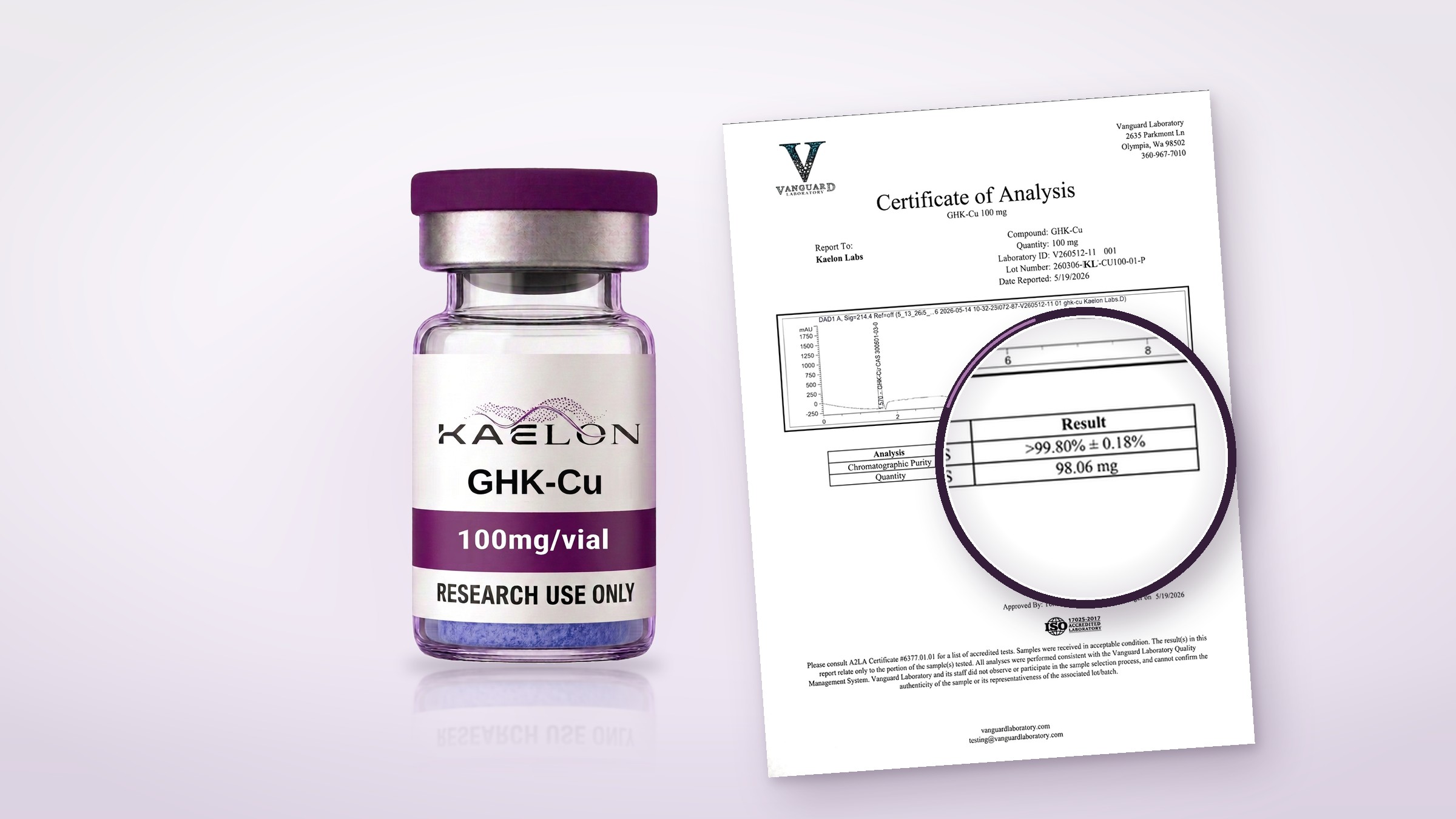
A certificate of analysis (COA) only proves something if five things check out: it matches your lot, it confirms identity, it says how purity was measured, it names the lab and the date, and you can verify it at the source. Each check takes seconds. Below, we run all five on a real Kaelon lot.
Most people read one number on a COA: the purity. On its own, it is the least useful number on the page. A purity figure tells you how clean the tested sample was. It doesn't tell you what the sample was, how much peptide it held, or whether it came from the vial in your hand.
01What is a certificate of analysis?
A COA is a laboratory's report on one tested sample. It records what was tested, which methods were used, what was found, and who ran the tests and when.
In research supply, it is the main evidence for what sits inside a vial. That makes it worth reading properly, and worth knowing what it can't tell you.
02The 60-second check
Run these five checks in order. If one fails, stop and ask the supplier before you order.
- Lot number. Find the lot (or batch) number on the certificate and on your vial. They should match exactly. A COA with no lot number describes some sample, somewhere. Finnrick, which publishes independent peptide test results, calls a vendor COA without the vendor's name and a batch ID "entirely worthless".
- Identity. Look for mass spectrometry (MS) data. MS measures the molecular mass of what is in the sample and compares it with the expected mass of the peptide. A match within the instrument's tolerance confirms the right molecule. HPLC on its own can't do this: it separates and measures peaks, but doesn't prove what the main peak is.
- Purity, with its method. A purity figure should come with the method behind it, normally HPLC with UV detection. Bachem, a leading Swiss peptide manufacturer, defines HPLC purity as the share of the target peptide among the UV-absorbing material detected at 220 nm. A purity figure with no method is just a number.
- Who tested it, and when. Look for a named laboratory and a test date. A lab you can look up beats an unnamed one. An old test date on a "new" lot is worth a question.
- Can you verify it at the source? A PDF is easy to edit. A certificate you can open at the source, from a lab portal or a lot page linked from your vial, is far harder to fake.
03Reading the chromatogram
The chart on an HPLC certificate is the chromatogram. Time runs along the bottom and the detector signal runs up the side. Each peak is something that left the column at a different moment.
- The tallest peak should be the peptide you ordered.
- Smaller peaks are impurities, usually related peptides such as shortened or altered sequences.
- Purity is the main peak's area as a share of the total peak area.
So 99.8% purity means the main peak made up 99.8% of everything the detector saw at that wavelength. Anything it can't see, such as water or many salts, isn't counted at all.
04A worked example: Kaelon GHK-Cu 100mg
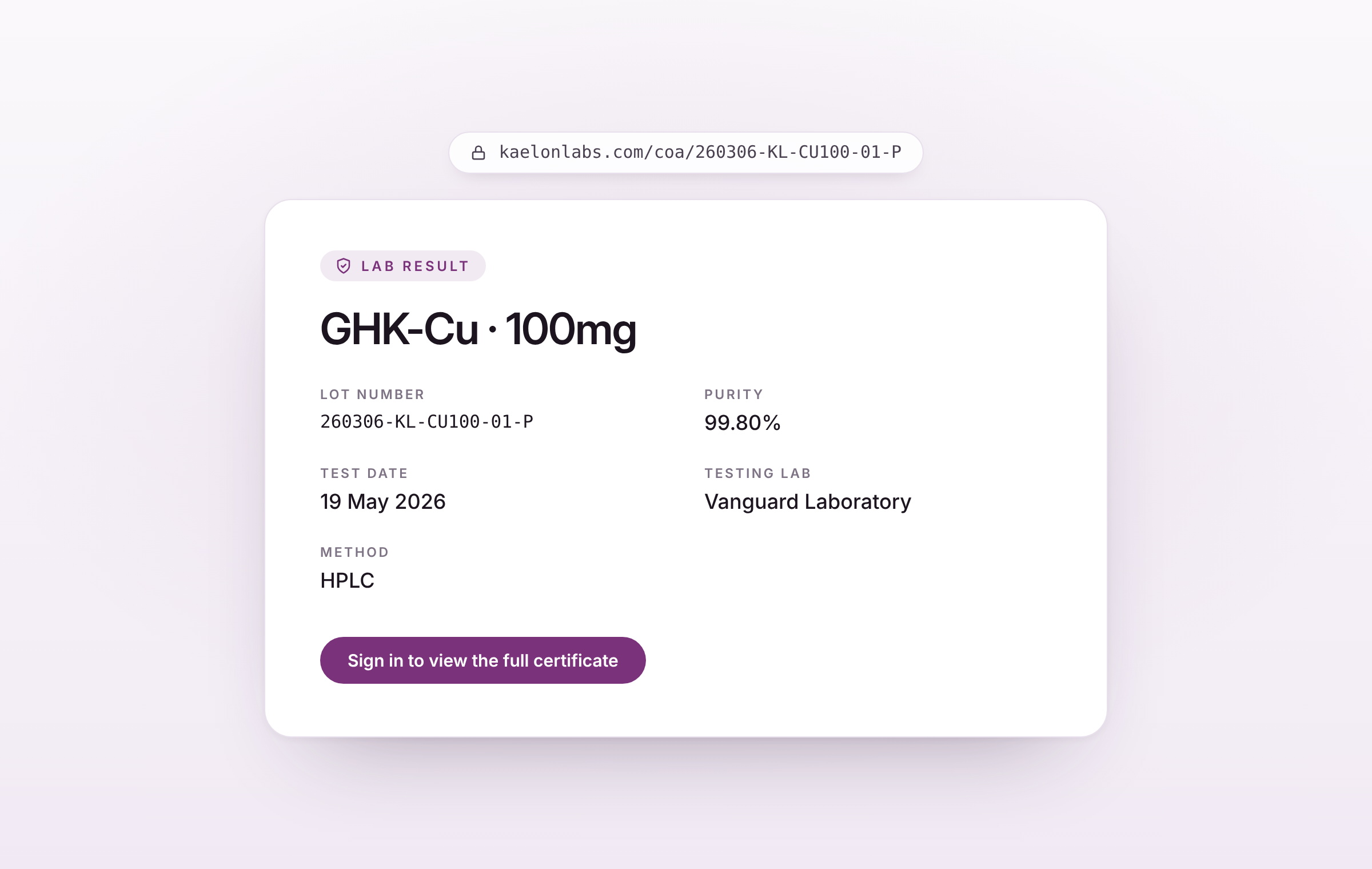
Every Kaelon vial carries a QR code. Scanning the code on a GHK-Cu 100mg vial opens its lot page. Here is how its certificate scores on the five checks.
| Check | What the certificate shows | Verdict |
|---|---|---|
| Lot number | 260306-KL-CU100-01-P | Matches the vial label |
| Identity | A peak labelled GHK-Cu on the HPLC trace, but no mass spec reading | Partly: mass spec would confirm it |
| Purity and method | Above 99.80% (± 0.18%), by HPLC-UV | Method stated |
| Lab and date | Vanguard Laboratory, reported 19 May 2026 | Named and dated |
| Source | Opened from the vial's own QR code | Checked at the source |
The same certificate also measures how much GHK-Cu is in the vial: 98.06 mg against the 100 mg on the label.
The lot page shows the summary to anyone. The full certificate opens with a free researcher account.
05What a COA can't tell you
A clean certificate still leaves gaps. It helps to know where they are.
- How much peptide is in the vial, unless it says so. Purity is not quantity. Some certificates add a quantity figure, like the 98.06 mg above. Without one, remember that peptide powder also holds counter-ions, such as acetate or trifluoroacetate, and water. The share that is actually peptide is the net peptide content, measured by nitrogen analysis or amino acid analysis. In Bachem's example, a net peptide content of 85% means 1 mg of powder holds 0.85 mg of peptide.
- Anything beyond the tests listed. HPLC purity counts peptide-related impurities only. It says nothing about salts, endotoxins or heavy metals unless those tests appear on the certificate.
- What happened after testing. A COA describes the sample on the day it was tested. Storage and shipping decide what reaches you, which is why cold-chain handling matters.
06Red flags
Any of these is a reason to ask questions before you order:
- No lot number, or one that doesn't match the vial
- A purity figure with no method
- No named laboratory, or a lab you can't find
- Missing or inconsistent dates
- The same chromatogram on certificates for different compounds
- A PDF that can't be checked anywhere
Check it yourself. Scan the QR code on any Kaelon vial. You land on that lot's lab result: compound, lot number, purity, method, testing lab and date. Sign in with a free account to open the full certificate.
07Where to go next
Read what 99%+ purity really means. To see every compound we stock with its lab results, create a free researcher account and browse the catalogue.
08Sources
- Finnrick, How to read a Certificate of Analysis (COA), 1 March 2026
- Bachem, What does net peptide content mean?
Research use notice
KAELON compounds are supplied exclusively for in-vitro laboratory research. They are not medicines and are not for human or veterinary use.
The KAELON catalogue is available to registered researchers.
Create a free researcher account to view the catalogue